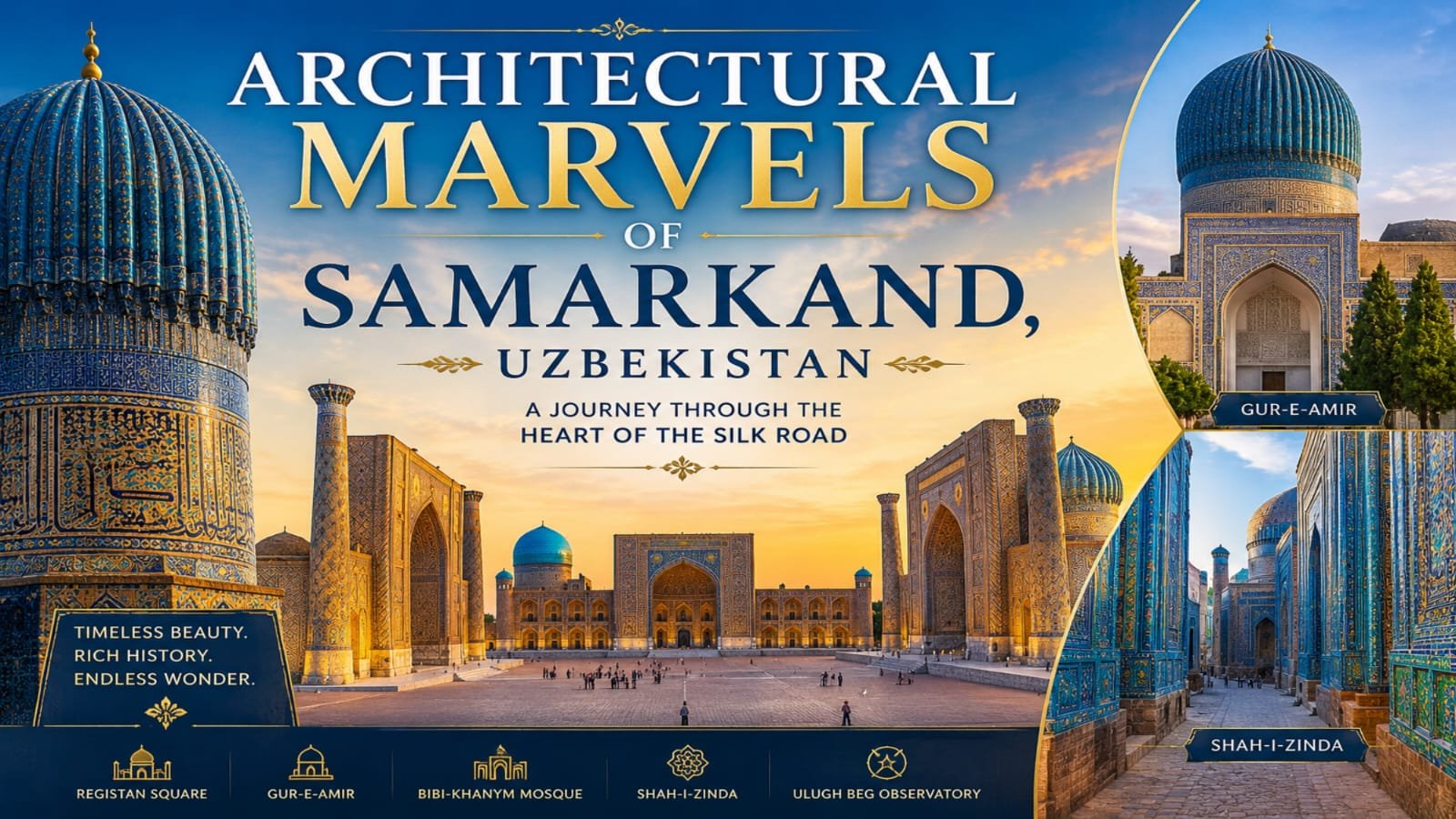
A Journey into One of the World’s Most Beautiful Historic Cities
There are cities that impress you with skyscrapers, and then there are cities that leave you speechless with centuries of history. Samarkand, Uzbekistan, belongs to the second category. Walking through its ancient streets feels like stepping into a chapter of the Silk Road, where traders, scholars, and travelers from across Asia and Europe once gathered. The city’s skyline is filled with turquoise domes, towering minarets, and intricate mosaics that seem to glow under the Central Asian sun. Every building tells a story of power, faith, science, and art. Whether you love architecture or simply enjoy discovering places with a rich past, Samarkand offers an unforgettable experience.
A City That Shaped the Silk Road
Samarkand is one of the oldest continuously inhabited cities in the world, with a history stretching back more than 2,700 years. Its greatest period came during the reign of Timur (also known as Tamerlane) in the 14th century, when he made Samarkand the capital of his empire. Timur invited architects, craftsmen, artists, and scholars from across Persia, India, and the Middle East to build a city unlike any other. The result is the magnificent collection of monuments visitors admire today. Although modern Samarkand has grown around these historic sites, the city’s architectural treasures remain remarkably well preserved.
Registan Square: The Heart of Samarkand
No visit to Samarkand begins anywhere other than Registan Square. Standing in the middle of this grand plaza is one of those travel moments that photographs simply cannot fully capture. Three magnificent madrasas surround the square, each decorated with brilliant blue tiles, geometric patterns, and elegant Arabic calligraphy.
Ulugh Beg Madrasa
Built in the early 15th century, this madrasa reflects the importance of education during the Timurid era. Ulugh Beg, Timur’s grandson, was not only a ruler but also a respected astronomer and mathematician. Students from across the Islamic world once came here to study science, philosophy, and religion.
Sher-Dor Madrasa
Built two centuries later, Sher-Dor is famous for its unusual tiger mosaics above the entrance. Islamic architecture rarely features animal images, making this decoration especially unique.
Tilya-Kori Madrasa
Its name means “Gilded.” Inside, visitors discover a mosque with richly decorated golden ceilings that create an atmosphere of remarkable elegance. As daylight changes, the colors of Registan transform from soft blue in the morning to deep gold at sunset, making every visit feel slightly different.
Gur-e-Amir: The Resting Place of Timur
The Gur-e-Amir Mausoleum is one of Samarkand’s greatest masterpieces. Its striking ribbed blue dome dominates the skyline long before you reach the entrance. Inside, polished marble, delicate carvings, and gold decorations create an atmosphere of quiet respect. Timur himself is buried here beneath a dark jade stone. Several members of his family, including Ulugh Beg, also rest within the mausoleum. Many historians believe this monument inspired later masterpieces such as the Taj Mahal’s architectural style.
Bibi-Khanym Mosque
Legend says Timur wanted the grandest mosque in the Islamic world after returning from his military campaigns. The result was the Bibi-Khanym Mosque, once among the largest mosques ever built. Even after centuries of earthquakes and restoration, its enormous entrance gate, towering arches, and giant blue domes continue to impress visitors. Standing beneath the massive portal gives a real sense of the ambition behind Timurid architecture.
Shah-i-Zinda: The Most Beautiful Street in Samarkand
Many travelers describe Shah-i-Zinda as the highlight of their visit. This stunning avenue is lined with beautifully decorated mausoleums built between the 11th and 15th centuries. Every building features unique tilework in shades of blue, turquoise, white, and deep cobalt. Walking slowly up the staircase feels almost like moving through an open-air museum. Fine geometric designs, floral patterns, and glazed ceramic mosaics cover nearly every surface. It’s one of the finest surviving examples of Islamic decorative art anywhere in Central Asia.
Ulugh Beg Observatory
Samarkand’s architectural achievements were not limited to mosques and mausoleums. In the 15th century, Ulugh Beg built one of the world’s greatest astronomical observatories. Although much of the original structure has disappeared, visitors can still see part of the enormous underground sextant used to calculate the positions of stars with remarkable accuracy. The observatory reminds visitors that Samarkand was also an important center of scientific discovery.
The Art Behind the Architecture
One of the first things visitors notice is the extraordinary craftsmanship. Tiny ceramic tiles are arranged into incredibly detailed geometric patterns. Arabic inscriptions flow across walls in elegant calligraphy. Massive domes are carefully proportioned to create perfect visual balance. The vibrant blue color seen throughout Samarkand became a signature of Timurid architecture. Under bright sunlight, these mosaics seem almost luminous. Even after hundreds of years, many of these details remain astonishingly well preserved.
Best Time to Visit
Spring (April to May) and autumn (September to October) offer the most comfortable weather for exploring Samarkand. Summer can be extremely hot, while winter is much quieter and gives visitors a chance to experience the monuments without large crowds. Early morning and late afternoon provide the most beautiful lighting for photography, especially around Registan Square and Shah-i-Zinda.
Local Tips for Travelers
- Wear comfortable walking shoes, as many historic areas are explored on foot.
- Dress modestly when entering religious sites.
- Visit Registan once during the day and again after sunset, when the lighting creates an entirely different atmosphere.
- Carry water during warmer months.
- Take time to admire the details rather than rushing between monuments. Some of the finest artwork is hidden in small corners and ceilings. Final Thoughts
Samarkand is much more than a collection of historic buildings. It is a city where architecture reflects centuries of culture, scholarship, religion, and artistic achievement. Every mosaic, dome, and carved doorway tells the story of a civilization that stood at the crossroads of the Silk Road. Whether you’re fascinated by history, architecture, or simply searching for one of Central Asia’s most remarkable destinations, Samarkand leaves a lasting impression. Long after leaving its ancient streets, you’ll still remember the shimmering blue domes rising against the clear Uzbek sky.

Welcome to Guide To Globe 46! I’m passionate about helping travelers explore the world with confidence and on a budget. Here you’ll find practical travel guides, hidden gems, solo travel tips, food experiences, and destination inspiration. My goal is to provide accurate, helpful, and easy-to-follow content that makes every journey memorable and enjoyable. Thank you for being part of this adventure!





Leave a Reply