Ever pondered what it might be like to stroll through the streets of a city that existed over 4,500 years ago? A site where people traded with far-off civilizations, created complex homes, maintained clean water systems, and organized their city with such care that even contemporary urban planners are in awe of it. Surprisingly, that location is in Pakistan.
Mohenjo-daro, a collection of old bricks tucked away in Sindh’s plains, is much more than that. One of the greatest archeological finds in the world, it serves as a potent reminder that one of the earliest and most developed civilizations in human history lived along the banks of the strong Indus River. Although Pakistan is frequently prais for places like Fairy Meadows, Skardu, and Hunza, Mohenjo-daro offers an entirely different kind of adventure. Instead of snow-capped peaks and verdant valleys, it transports you back in time to the places where families, priests, craftsmen, and merchants lived thousands of years before the modern world.
There is more to Mohenjo-daro than just sightseeing. It’s like entering a lost era of human history, where each worn brick and old wall holds a tale just waiting to be unearth.
Why Every Traveler Should Put Mohenjo-daro on Their Bucket List
Few people are aware that Pakistan is home to one of the world’s oldest planned cities, despite the fact that many tourists long to see the pyramids in Egypt, the Colosseum in Rome, or the ancient temples in Greece. Because it offers something genuinely unique, Mohenjo-daro should be on every history buff’s bucket list.
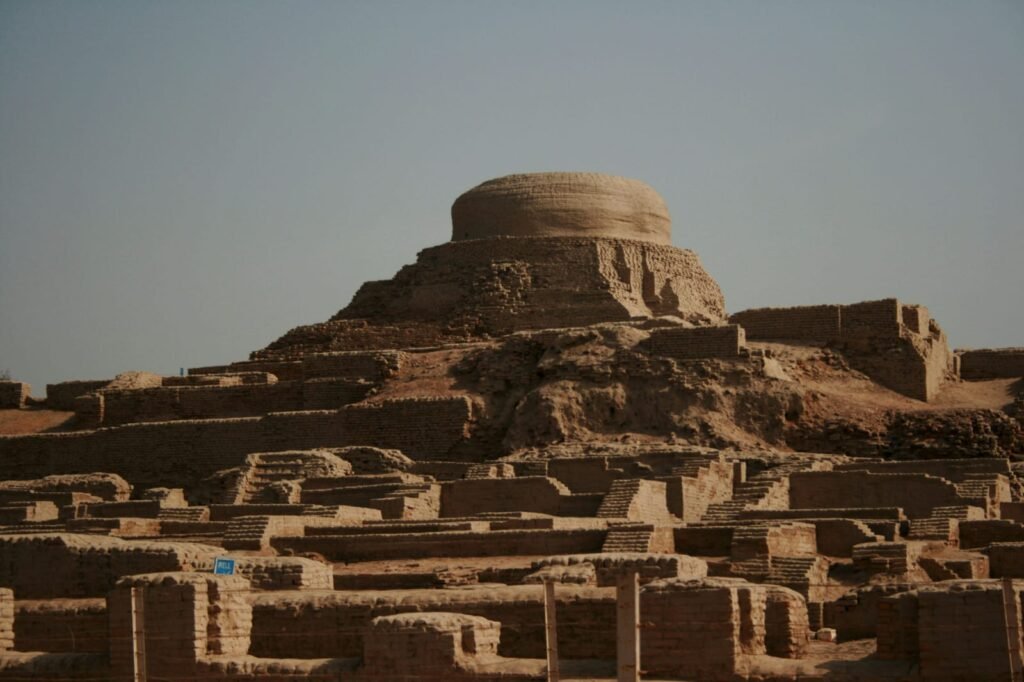
Mohenjo-daro portrays the tale of common people, in contrast to monuments erected to glorify monarchs or conquerors. It shows how families lived, how towns were run, how trade thrived, and how a society attain a remarkable degree of organization without the use of contemporary technology.
As you walk through its wide streets, it becomes clear that this wasn’t simply an ancient settlement. It was a carefully design city with neighborhood, marketplaces, wells, drainage systems, public buildings, and community spaces. Even after thousands of years, the city’s layout still reflects careful planning that many modern cities struggle to achieve.
Whether you’re passionate about archaeology or simply curious about the world’s oldest civilizations, Mohenjo-daro leaves a lasting impression that few destinations can match.
An Exploration of the Indus Valley Civilization
You must first comprehend the society that created Mohenjo-daro in order to fully appreciate it.The Indus Valley Civilization had already built prosperous cities throughout modern-day Pakistan and portions of northwest India by 2600 BCE, while most of the world was still growing small farming settlements. Mohenjo-daro became one of its most significant urban centers, alongside Harappa.
Tens of thousands of people lived here formerly, according to historians. The city was a hive of activity, with farmers bringing fresh fruit to the markets, craftspeople making jewelry and ceramics, merchants trading things, and kids playing in peaceful residential districts.
The civilization stretched across a vast region connected by trade routes that reached as far as Mesopotamia. Archaeologists have discovered evidence that people from Mohenjo-daro exported cotton textiles, beads, precious stones, pottery, and metalwork while importing valuable materials from distant lands.
The apparent tranquility of the Indus Valley Civilization is perhaps its most intriguing feature. There is relatively little evidence that Mohenjo-daro relied either on warfare or enormous royal palaces, in contrast to many other ancient communities. Rather, city planning, engineering, trade, and community life were its greatest accomplishments.
Researchers are still finding new hints regarding the true level of sophistication of this society.
The Discovery That Changed South Asian History
For centuries, the ruins of Mohenjo-daro lay hidden beneath layers of earth, unnoticed by the outside world. Local villagers knew about the large mounds scattered across the landscape, but no one imagined that an entire ancient city rested beneath them.
Everything changed in 1922 when archaeologist Rakhal Das Banerji began excavations at the site. As workers carefully removed centuries of soil, they uncovered streets, houses, wells, public buildings, and countless artifacts that revealed the existence of a civilization far older than anyone had expected.
The world’s historians were astound by the revelation. Until then, a lot of people thought that South Asia’s old urban civilization started much later. That understanding was entirely alter by Mohenjo-daro.
Only a small fraction of the city was discovered by archaeologists throughout the ensuing decades. But even that modest excavation demonstrat exceptional engineering prowess and intricate urban design. According to experts a significant portion of Mohenjo-daro is still hidden. Beneath the earth preserving innumerable mysteries that may eventually be discover by future generations.
Walking Through the Ancient Streets of Mohenjo-daro
Walking down streets that were inhabit thousands of years ago is one of the most memorable experiences when visiting Mohenjo-daro.
Mohenjo-daro feels immediately ordered, in contrast to many old ruins that seem disorganized. Wide streets meet at right angles to form a tidy grid layout that is reminiscent of contemporary urban design. Families used to dwell in residential communities where smaller lanes branched off.
It’s easy to see children running through tiny streets, shopkeepers opening their doors at morning, and artisans creating delicate jewelry or molding ceramics within neighboring studios as you stand amid these ruins.
Standard-baked bricks were used in the city construction giving structures a uniform look. This degree of preparation implies that builders adhered to stringent building codes, which were uncommon in those societies.
Even though roofs and higher level have been worn away over time. The foundations that remain reveal an amazing tale of how carefully this city was plan.
Engineering That Was Centuries Ahead of Its Time
The engineering of Mohenjo-daro is arguably its most remarkable aspect.Wells, either private or shared, provided clean water to almost every home. Covered brick drains beneath the streets removed wastewater, preventing pollution and maintaining the city’s exceptional cleanliness.
Even more amazing, these drainage lines had inspection apertures that let maintenance personnel clear obstructions as needed.
Many homes also contained private bathing areas connected directly to the city’s drainage network.When you consider that these systems were built more than four thousand years ago, it becomes clear why engineers and historians continue studying Mohenjo-daro today. In many ways, its approach to sanitation was centuries ahead of its time.
The Great Bath of the Ancient City
A trip to Mohenjo-daro would not be complete without seeing the Great Bath, the city’s most well-known building.It looks at first like a straightforward rectangular pool made of baked bricks. However, the more you understand about it, the more intriguing it becomes.
The nearly 12-meter-long bath was meticulously waterproofed with bitumen to prevent leaks. The surrounding chambers imply that people met here for important events, and the wide staircases that descend into the pool from both ends.
Many people think the Great Bath was crucial to religious events or communal rituals even though historians cannot say for sure how it was used. Some say it represent cleansing prior to significant occasions.Regardless of its original intent, the Great Bath continues to astound every visitor who stands next to it and is regard as one of the greatest engineering feats of antiquity.
More Than Just Ruins
You’ll discover that Mohenjo-daro was much more than just a group of homes as you continue to explore the area. Large public structures thought to have function as meeting rooms, storage facilities, or administrative hubs have been found by archaeologists.
The Granary, which may have been used to store food supplies to feed the city’s expanding population, is one of the most striking buildings. Spacious halls nearby suggest that official events or communal get-together play a significant role in urban life.
The residential areas are just as interesting. Numerous houses have central courtyards that naturally let in sunlight and fresh air. Some were unexpectedly roomy, while others were modest, indicating a well-run community with talented artisans and builders.
Mohenjo-daro Daily Life: An Overview of the Ancient World
Archaeologists have found enough evidence to create an intriguing picture of how people lived in Mohenjo-daro. despite the fact that no written texts describing daily life have been satisfactorily translated.
The city would probably come alive with activities early every morning. Fresh grains, vegetables, fruits, and cattle were likely brought into the city by farmers from surrounding towns. Craftsmen started forming clay into pottery, merchants opened their stores. and expert jewelers polished beads produced from shells.carnelian, and lapis lazuli.
Families lived in well-built brick houses that were both practical and comfortable. Many homes had several rooms surrounding an open courtyard where children could play and families gathered during the cooler evenings. Some houses even had their own wells, meaning residents had direct access to clean water without leaving their homes.
Unlike many ancient cities where only the wealthy enjoyed good living conditions. Mohenjo-daro appears to have offered surprisingly similar housing standards for much of its population. This suggests a society that valued organization and community rather than displaying extreme differences between social classes.
Art, Culture, and Incredible Craftsmanship
Mohenjo-daro’s artistic talent is one of its most fascinating features.Beautifully painted ceramics, bronze tools, carved stone sculptures, vibrant beads, copper ornaments, children’s toys, and decorative seals that showcase a sophisticated and imaginative culture have all been found during excavations.
The Dancing Girl, a little bronze figurine, is arguably the most well-known find. Even though the sculpture is barely 11 centimeters tall, it has amazing self-assurance and movement.
The steatite stone statue of the Priest-King is another famous find. The figure’s intricate craftsmanship demonstrates the amazing artistic ability of the culture, despite the fact that little is known about its true identity.
Additionally, children had clay toys such as spinning items, whistles, animals, and tiny carts. These findings serve as a reminder that play, celebration, and creativity were all part of life thousands of years ago, in addition to labor.
A Civilization Connected to the World
It is easy to assume that people living over four thousand years ago rarely traveled far from home, but Mohenjo-daro tells a different story.Archaeologists have found evidence that the city maintained trade connections with distant civilizations, including Mesopotamia, located in present-day Iraq.
Merchants exchanged cotton textiles, precious stones, beads, metals, pottery, and agricultural products. Standardized weights discovered throughout the city indicate that trade was carefully organized, making business transactions fair and reliable.This international trade network helped Mohenjo-daro become one of the wealthiest and most influential cities of its time.
The Mystery of the Indus Script
Among the greatest mysteries surrounding Mohenjo-daro is its undeciphered writing system.Hundreds of small seals have been discovered bearing tiny symbols alongside images of animals such as bulls, elephants, unicorn-like creatures, and rhinoceroses. Yet despite decades of research, no one has successfully translated the script.
If the language is ever decoded, historians may finally learn the names of the city’s rulers, understand its beliefs, discover how its government worked, and perhaps even uncover personal stories of the people who once called Mohenjo-daro home.Until then, the silent symbols remain one of archaeology’s greatest unsolved puzzles.
What Caused Mohenjo-daro to Vanish?
One question continues to fascinate historians around the world: What happened to Mohenjo-daro?
Unlike many ancient cities destroyed by war, there is little evidence that a massive invasion caused its downfall. Instead, researchers believe several factors may have contributed to the city’s gradual decline.Some experts suggest that repeated flooding from the nearby Indus River weakened buildings and forced residents to relocate. Others believe changing river routes reduced access to water and trade, making the city less sustainable.
Climate change is another possible explanation. Long periods of drought may have affected agriculture, making it difficult to support a large urban population.Some historians also point to economic decline or changing trade routes that reduced the city’s importance.The truth is that no single theory fully explains the disappearance of Mohenjo-daro, making it one of history’s most fascinating mysteries.
A UNESCO World Heritage Site
Recognizing its extraordinary historical importance, UNESCO declared Mohenjo-daro a World Heritage Site in 1980.
Today, archaeologists and conservation experts continue working to preserve the fragile ruins from erosion, flooding, and the effects of weather. Since the ancient bricks have survived for thousands of years, protecting them for future generations has become an international priority.Visitors are encouraged to respect the site by staying on designated pathways and avoiding climbing on ancient structures.
Planning Your Visit to Mohenjo-daro
If you’re planning to explore this remarkable destination, a little preparation will make your trip far more enjoyable.
Best Time to Visit
The ideal time to visit Mohenjo-daro is between November and February. when temperatures are pleasant for walking around the archaeological site. Summers in Sindh can become extremely hot, often exceeding 45°C, making sightseeing uncomfortable.
How to Reach
Mohenjo-daro is located about 28 kilometers from Dokri and around 85 kilometers from Larkana. Travelers can reach Larkana by road, rai,or domestic flights from major Pakistani cities before hiring a taxi or local transport to the archaeological site.
Entry and Museum
The site includes a museum displaying original artifacts discovered during excavations, including pottery, tools, jewelry, seals, sculptures, and household objects. Visiting the museum before exploring the ruins helps you better understand what you’re seeing outside.
Travel Tips
- Start your visit early in the morning to avoid the afternoon heat.
- Wear comfortable walking shoes, as you’ll spend several hours exploring.
- Carry plenty of drinking water.
- Bring sunscreen, sunglasses, and a hat during warmer months.
- Hire a local guide if available to better understand the history behind each structure.
- Respect the archaeological site by avoiding climbing on the ancient walls.
Nearby Places Worth Exploring
If you’re already visiting Sindh, consider adding a few nearby attractions to your itinerary.The city of Larkana offers local markets and traditional Sindhi cuisine, giving visitors a chance to experience the region’s rich culture. You can also explore the peaceful banks of the Indus River or visit nearby historical sites that showcase Sindh’s remarkable heritage.
Combining Mohenjo-daro with other destinations in Sindh creates a journey that blends history, culture, and local traditions into one unforgettable experience.
Concluding Remarks
There is much more to Mohenjo-daro than just an archaeological monument. It serves as a potent reminder that the people who lived in the Indus Valley. Thousands of years ago used intelligence, creativity, and meticulous planning to create one of the most complex urban civilizations in history.
It is unlike any other place in Pakistan to stroll through its historic streets. Long before many well-known empires existed, a culture that valued order, cleanliness, craftsmanship. Communal living is depicted in every brick, well, and crumbling wall.
In order to fully comprehend the rich history of Pakistan. Mohenjo-daro needs to occupy the top spot on your travel itinerary. It’s more than just a trip back in time. It’s a chance to see one of humanity’s greatest achievements and honor a legacy that still motivates people today.

Welcome to Guide To Globe 46! I’m passionate about helping travelers explore the world with confidence and on a budget. Here you’ll find practical travel guides, hidden gems, solo travel tips, food experiences, and destination inspiration. My goal is to provide accurate, helpful, and easy-to-follow content that makes every journey memorable and enjoyable. Thank you for being part of this adventure!





Leave a Reply